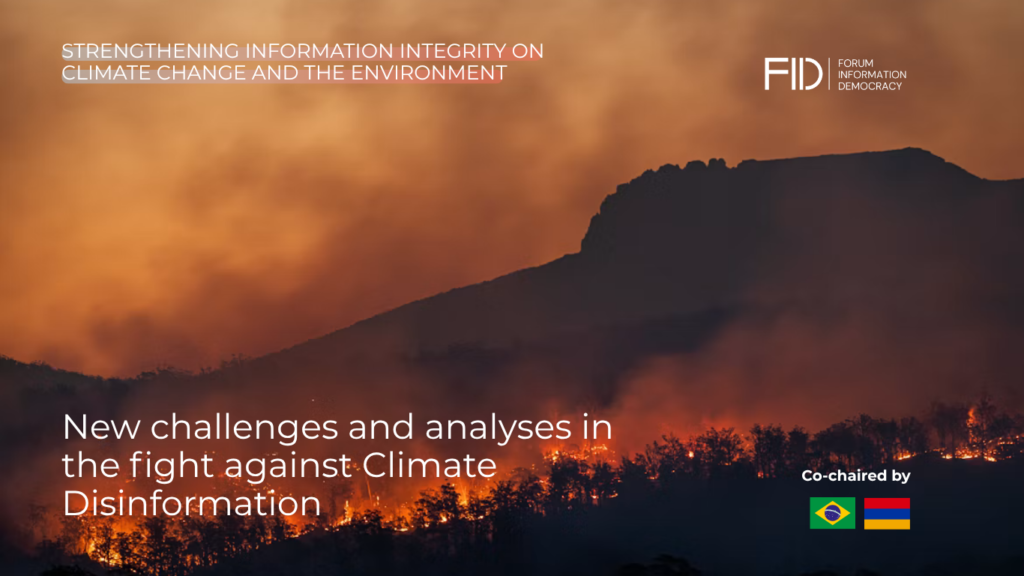
The Forum on Information and Democracy held the first meeting of its workstream on strengthening information integrity on climate and environmental issues on 17 April 2025, under the co-presidency of Armenia and Brazil.
Launched in February 2025 and co-chaired by the governments of the Republic of Armenia and the Republic of Brazil, this workstream of the International Partnership for Information and Democracy aims at addressing key challenges of the information space on climate change and other environmental issues. It convenes civil society experts, international organisations, and government representatives from States of the Partnership to discuss solutions, exchange best practices, and foster global cooperation on the matter.
Armenia and Brazil at the forefront of putting information integrity on the environmental agenda
Respectively hosting the upcoming COP30 on climate change and the COP17 on biodiversity, representatives of the Brazilian and Armenian governments shared a similar vision: the critical moment for their countries to address climate and environmental disinformation and to develop a shared framework for action.
Nina Santos, Head of the Special Advisory Office of the Communications Secretariat of the Brazilian Presidency and Deputy Secretary for Digital Policies, delved into the ambitions of the Global Initiative on Information Integrity on Climate Change launched during the Brazilian G20 presidency in 2024. Among others, it aims at making the issue of preserving information integrity more concrete and relevant to people’s daily lives. Another priority this Initiative is setting is fostering collaboration, both locally and internationally, by joining monitoring efforts, networks, and actions.
Anush Harutyunyan, Head of Information and Digital Diplomacy Division, Media and Public Diplomacy Department, Ministry of Foreign Affairs of Armenia, highlighted that it is a critical moment for discussion on COP 17 and COP 30 which will shape the future. While little has been done to connect the topics of climate disinformation and environmental information so far, Ms. Harutyunyan pointed out that the community is at the beginning of building a science-based dialogue aimed at driving research and evidence-based policy action on information integrity on environmental issues.
Key challenges in the information space
Several researchers and civil society experts presented the challenges that the information space is presenting for climate change and other environmental issues highlighting the coordinated and financed nature of climate disinformation, the attacks against environmental journalists and the lack of trust in the information space.
Climate disinformation economics: Andrew Heffernan, professor of international relations and comparative politics at the University of Ottawa, and rapporteur of the workstream, emphasized that climate change disinformation remains politically and financially motivated, strategically targeted, and often backed by powerful actors with a vested interest in maintaining the status quo. Its impact is furthermore amplified by the structural weaknesses of today’s information system.
Overcoming conflicts of interest: Stephanie Hankey, co-founder of Tactical Tech, shared findings within the framework of the organisation’s initiative ‘Digital Influence and Climate Friction’, exposing various tactics fueling climate disinformation and solutions to counter them. Among them, Ms. Hankey exposed the need to adopt a cross-disciplinary and portfolio approach. If technology can help counter climate change, these solutions are often funded or controlled by major tech companies that profit from the spread of misinformation. Relying solely on tech-driven solutions risks reinforcing the very systems that perpetuate disinformation.
Protecting environmental journalists: Artur Romeu, Director of the Latin America Office at Reporters without Borders (RSF), focused on the role of environmental journalists and how attacks against them create a vacuum that can be filled by disinformation. Mr. Romeu notably noted that the majority of natural resource extraction happens in the same countries where press freedom is under the most serious threats, with violations particularly concentrated in Asia and in America.
Take part in the workstream
In the coming weeks, the workstream will host additional meetings to build on the discussions initiated, foster cross-disciplinary collaboration, and develop concrete, science-based solutions. To support this effort, the Forum will seek expert insights to complement its findings. More information will be available shortly.
All interested parties, government representatives, civil society experts or researchers, are welcomed to join the workstream and take part in upcoming sessions. Reach out to the Forum’s team at contact@informationdemocracy.org to learn more about our next sessions.