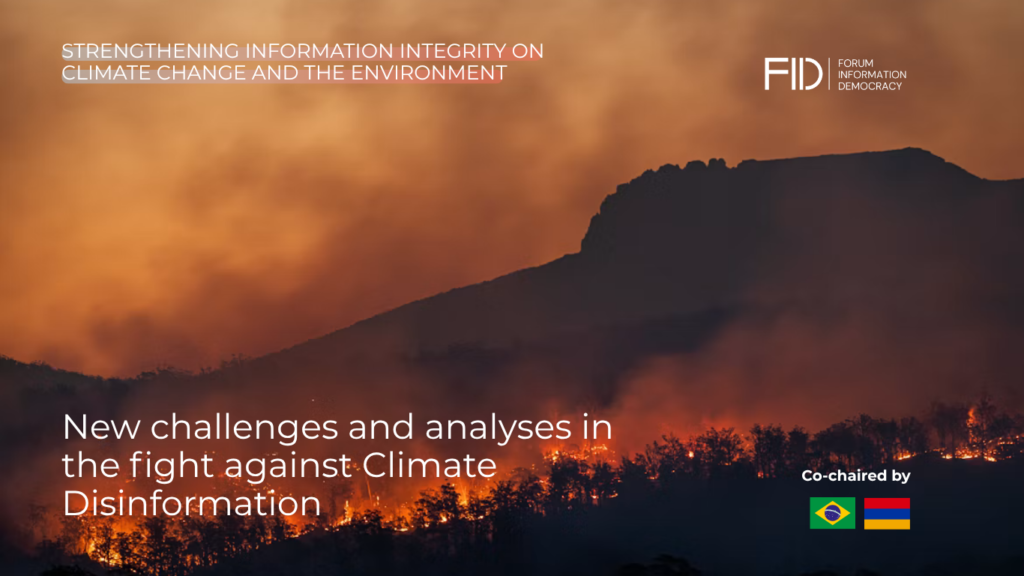
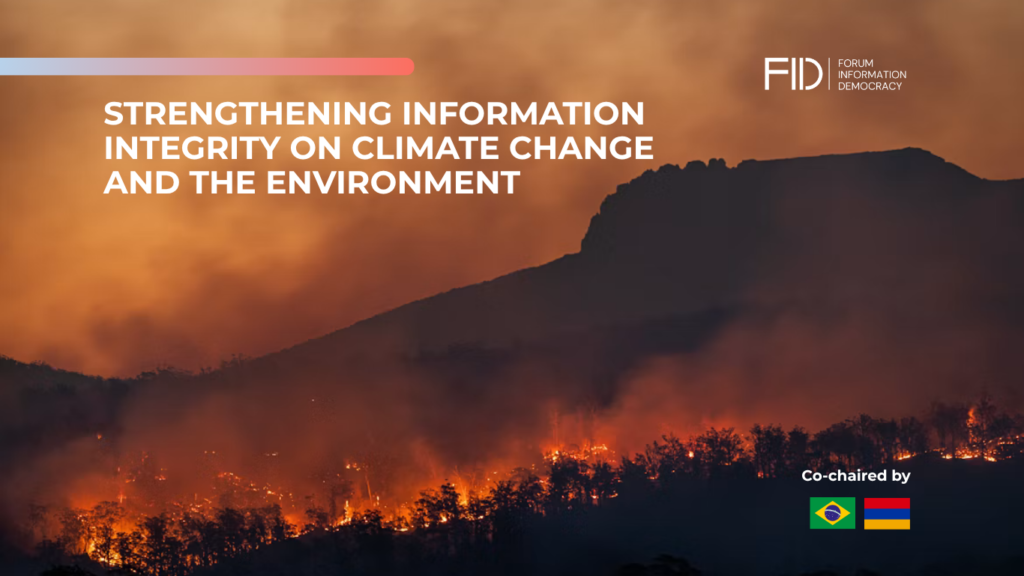
The States of the Partnership and the Forum’s CSO Coalition gathered for an online meeting of the workstream on information integrity, climate change and environmental issues under the leadership of Armenia and Brazil on 1 October 2025. The meeting served to explore how environmental protection is hindered by disinformation and lack of reliable information and to explore first solutions.
As the international community is giving more attention to climate disinformation, the objective of the meeting was to assess and give visibility to the multifaceted nature of information integrity challenges on environmental issues. Participants highlighted that beyond climate disinformation, other areas such as biodiversity are impacted by disinformation campaigns. Worsening the situation are the attacks and harassments of environmental journalists and defenders, creating a void that can be filled by malicious actors and vetted interests.
Case studies from Latin American countries illustrated the challenging situation. Deep digital inequality in the region undermines access to accurate information leaving marginalized communities without reliable connectivity. In addition, escalating threats to environmental journalism and physical risks, digital harassment and surveillance of environmental defenders reduce reporting and access to reliable information. Thus, misinformation has fueled polarization on topics such as energy transition while failing to address the needs and concerns of local communities. Even though international instruments such as the Escazú Agreement enshrine the right to participation and information on environmental issues, they are not fully implemented.
Emerging Practices to strengthen access to reliable environmental information
Representatives from States of the Partnership shared insights into ongoing strategies that aim to increase access to reliable environmental information. Such strategies include multiple approaches from strengthening state institutions to ensure the provision of accurate and reliable information to fostering collaboration between governments and private sector actors and to developing civic education programs to build resilience.
Biosphere reserves were also presented as unique platforms for engaging local communities, fostering dialogue, and providing solutions-oriented engagement. Finally, the need to train journalists on environmental issues was highlighted as vital to ensure that scientific findings reach the public in accessible and engaging ways.
Information integrity @ COP30
The meeting concluded with an outlook to COP30 hosted by Brazil in Bélem in November 2025. The Brazilian government has put information integrity on the agenda with a specific objective in the COP30 Action Plan, dedicated sessions and a Mutirão bringing different actors and initiatives together. It builds upon the Global Initiative on Information Integrity on Climate Change launched as an outcome of the G20 Presidency of Brazil.