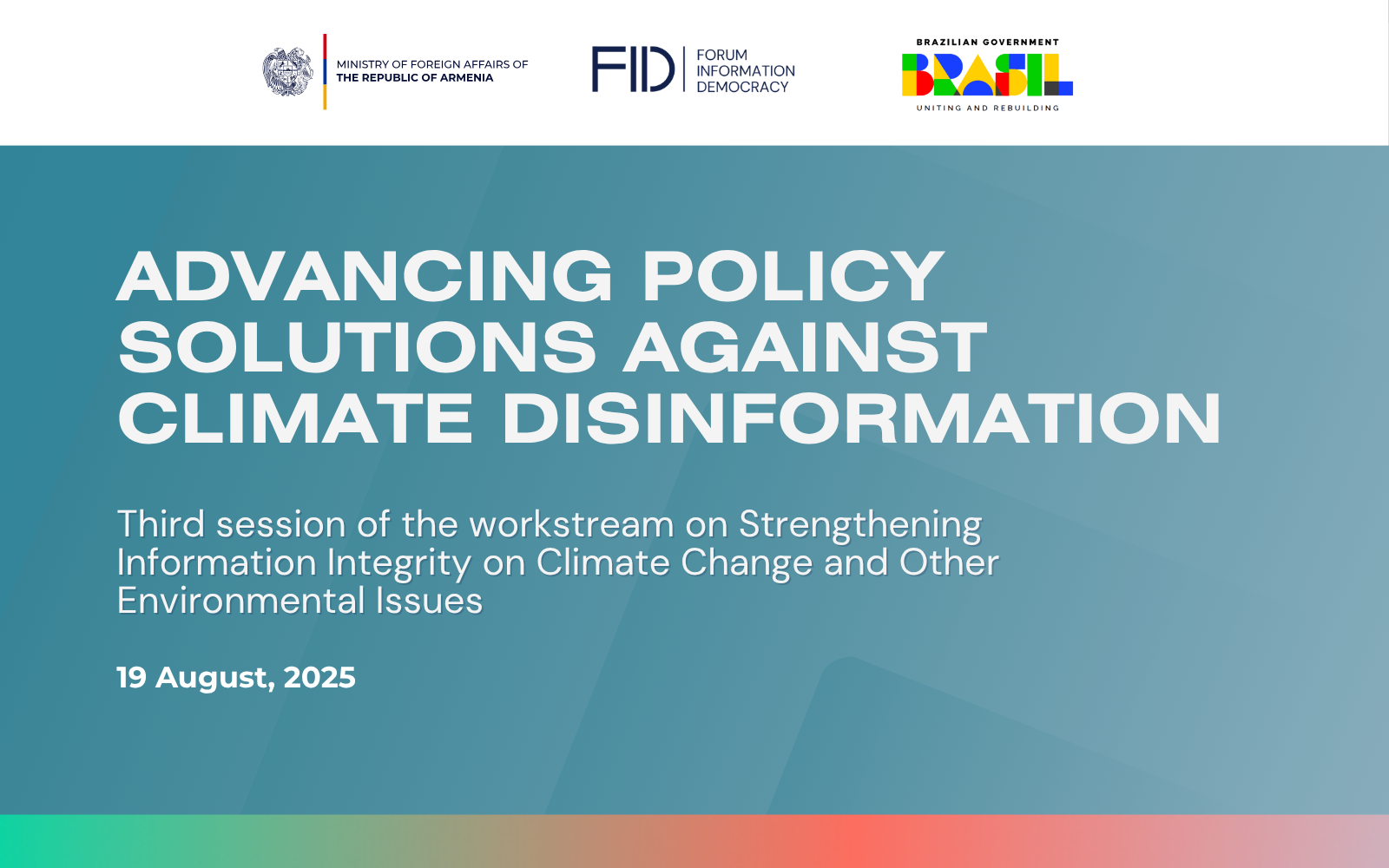
On July 3, 2025, the Partnership for Information and Democracy convened its third closed-door session as part of its workstream on strengthening information integrity on climate change and other environmental issues. Co-chaired by Brazil and Armenia, the meeting marked a shift from diagnosing the challenges of climate disinformation to exploring concrete policy solutions.
As the international community moves toward COP30 (Brazil) and COP17 (Armenia), this session helped clarify regulatory and institutional options for embedding information integrity into the climate governance agenda. Participants agreed that the challenge is no longer limited to debunking fake news, but to developing frameworks that address the systemic drivers of climate disinformation.
Diagnosis
Building on the insights of previous sessions, participants reflected on the evolution of climate disinformation. Experts noted that denialism has largely given way to more insidious tactics of “strategic skepticism”, as described by Prof. Klaus Bruhn Jensen from the International Panel on the Information Environment (IPIE).
This aims at delaying action rather than denying facts, by reframing climate action as uncertain, costly or unrealistic. Such narratives, often amplified by fossil fuel interests, political actors and certain media outlets, target policymarkers and erode consensus to stall regulation and actions.
Mapping the policy landscape
Against this backdrop, participants reviewed legal and regulatory frameworks already in place. Examples included Australia’s Code of Conduct and the EU’s Digital Services Act (DSA). Although still in early stages of adoption, these instruments may offer avenues to inform approaches to climate-related disinformation.
Nina Santos, from the Brazilian Presidency, started by emphasizing that regulatory measures must respect freedom of expression and press freedom. A recent Supreme Court ruling is a major shift in platform liability redefining platforms as active actors responsible for content, introducing duties while prompting legislative follow-up through draft Digital Services legislation.
These examples illustrate that while regulation can provide a foundation, effective solutions require complementary measures of transparency, accountability, and cross-sector collaboration.
Four key levers to counter climate disinformation
Experts from the Center for Countering Digital Hate, the Conscious Advertising Network and the Forum identified four critical levers to counter this trend.
- Platform and ad tech accountability: reducing the reach and profitability of algorithmic and advertising systems that amplify denial and profit from disinformation is the top priority. This also requires transparency of the whole ad system, which would enable companies to place their ads responsibly.
- Polluter and lobby transparency: to combat fossil fuel interests, which often fund misleading campaigns and greenwashing efforts, citing measures such as the Hague’s fossil fuel advertising ban or the EU’s Green Claims Directive.
- Protection against coordinated influence operations: particularly in moments of political visibility, such as elections or COP summits.
- Cross-cutting research and data transparency: enabling evidence-based strategies, with tools like Article 40 of the DSA or UNESCO’s Global Initiative for Information Integrity.
Together, these measures outline a multi-level approach that combines regulation, transparency and collaboration to address climate disinformation.
Conclusion
The meeting concluded with a call to strengthen research and knowledge-sharing, not only on climate disinformation but also on broader environmental narratives. The Forum will reconvene the workstream in October with a focus on information integrity challenges for biodiversity and other environmental issues.
By advancing collective understanding and policy innovation, the Partnership for Information and Democracy reaffirms its commitment to safeguarding information integrity in the face of global environmental challenges. The workstream findings will continue informing discussions, including during the upcoming COP30 that will take place in Belém, Brazil, in November 2025.