Many governments signed the Belém Declaration on Information Integrity on Climate Change. Comprehensive strategies to implement it are still lacking, but inspiring practices are conducted by policy makers in several countries as discussed during the workstream meeting. It was the occasion to present the preliminary results of the first mapping exercise of its kind covering 23 countries and the EU.
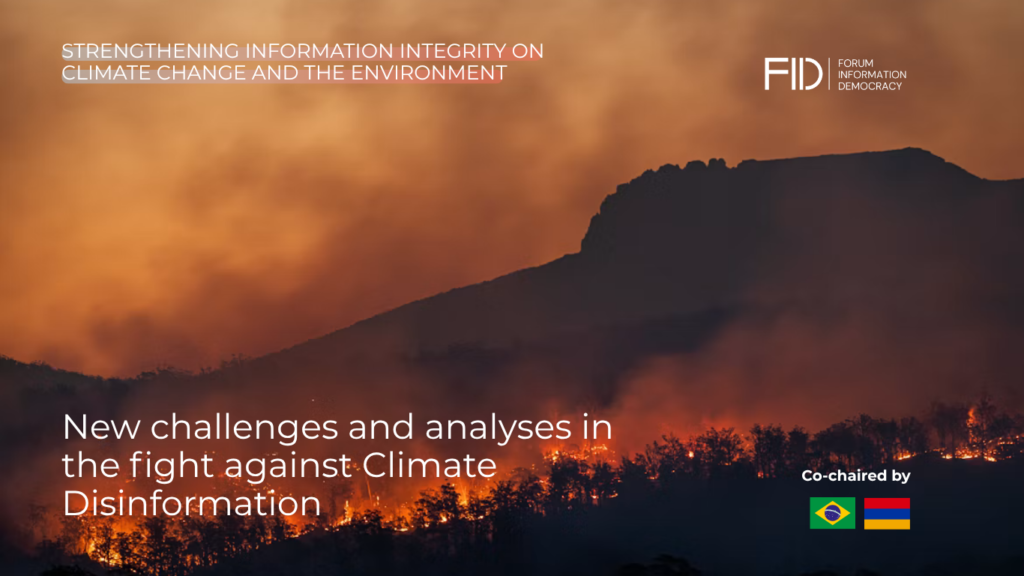
On 16 September 2026, the Forum on Information and Democracy held the eighth overall and the third annual meeting of the Workstream on Information Integrity on Climate Change & Other Environmental Issues, co-chaired by Brazil and Armenia.
This meeting offered insights about the FID’s mapping exercise to assess countries’ regulatory and policy frameworks to promote climate and environmental information integrity. It also enabled a deep dive into specific countries’ practices notably by Poland, Canada and France as well as civil society efforts regarding advertising transparency.
Insights from States policy frameworks
Participants discussed the first results of a mapping that investigates the platform, media, climate and greenwashing regulations as well as policies for institutional communication, literacy and the fight against disinformation. The findings highlight that while approaches to provide access to climate information and promote literacy are wide-spread, regulation of platforms and greenwashing still need to be further adapted to the challenges. A variety of stakeholders are involved in countries’ responses including ministries of environment and regulatory authorities. Protecting and supporting environmental journalism remains a blindspot whereas cooperation with civil society and researchers is an important part of countries’ responses.
Good practice examples
The second part of the session enabled participants to deep dive into specific approaches implemented by countries. This included a presentation of Environment and Climate Change Canada’s departmental counter-disinformation strategy which has an important focus on prevention. The Ministry of Climate and Environment in Poland presented the wide-ranging activities of the Climate and Environmental Disinformation Prevention Unit working notably with civil society and journalists. France presented its approach both at the international level as well as at the national level including the foreseen national action plan for access to information on climate and the environment. The Conscious Advertising Network explained the objectives of the forthcoming Charter for Accountable Climate Advertising which aims to transform the sector to demonetise disinformation.
Next steps
Ahead of COP17 in Armenia and COP31 in Türkiye, FID will publish the first international mapping exercise providing a state of the art and inspiring practices to support countries in their implementation. The report’s findings will be discussed at COP31. COP31 will also feature important negotiations on the ACE framework, the only negotiation item on the COP31 agenda that currently directly deals with information integrity and to which the report contributes.