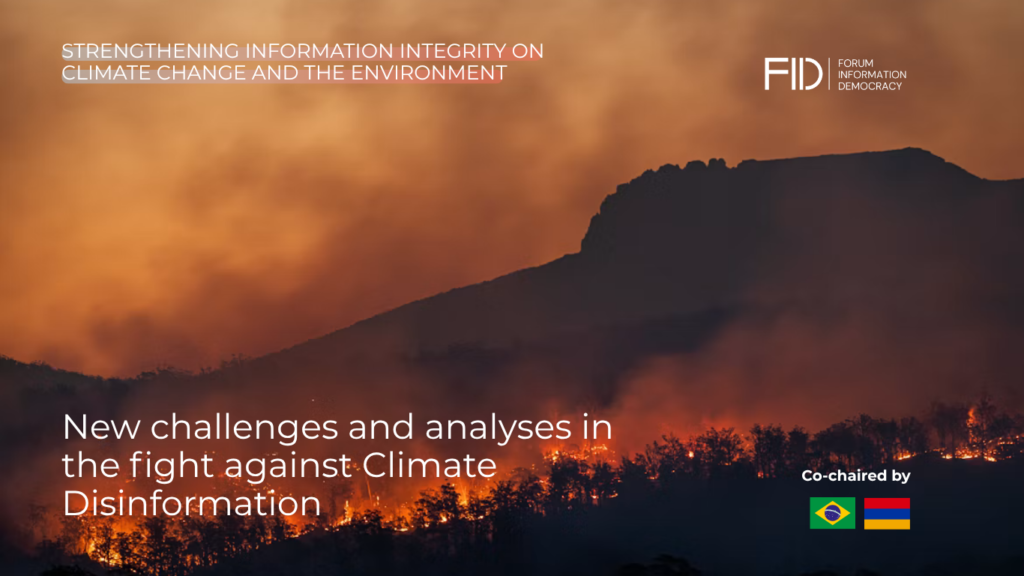
A new report from the Forum on Information and Democracy (FID) finds notable political will and promising efforts to strengthen information integrity on climate change in at least 23 countries and the EU. However, it also finds persistent gaps, such as lack of national strategic plans of action to tackle climate disinformation and greenwashing from the fossil fuel lobby, which is most urgently needed.
As the world prepares for COP 17 on Biodiversity (22-30 October) and COP31 on climate change (9-22 November), the findings pave the way for policymakers and regulators to take the urgent action needed to tackle climate disinformation.
Covering 23 countries and the EU, the report was developed within the framework of the organization’s priority workstream on Information Integrity on Climate and the Environment, co-chaired by Armenia and Brazil. It shows that while political traction and public awareness are rising, most countries still don’t have a national strategic plan of action to counter climate disinformation and denialism.
“Initially aimed at slowing down ecological transition, climate and environmental disinformation has become a democratic issue, fueling polarization and sawing distrust. One year after the “COP of Truth” in Belém, the report we release today maps what has been done, what works and what could be further strengthened. It is a resource for all stakeholders seeking solutions to the two great challenges of our time: climate change and information chaos,” says Camille Grenier, Executive Director at the Forum on Information and Democracy.
From Belém to Antalya
The report is an outcome of the COP30 Action Agenda, a series of commitments made by stakeholders in Belém, and represents a collective effort. FID has worked with partners from governments and civil society to understand how existing frameworks are being leveraged to counter climate disinformation, how governments are protecting environmental journalism and progress to establish national action plans.
First insights were provided at the UN Framework Convention on Climate Change in Bonn in June 2026 as well as at the UN General Assembly High-Level week in September. Authored by Cecile Simmons, rapporteur of the workstream facilitated by FID, it builds on the international movement ignited by the Global Initiative for Information Integrity on Climate Change co-chaired by the government of Brazil, the UN and UNESCO.
The report provides an overview of existing practices, highlighting promising avenues in legislative changes, institutional setups, communication efforts, literacy and prebunking, and support for environmental journalism. In that sense, it provides a first assessment useful for policymakers and civil society organizations.
Main findings from the report
Legal and regulatory frameworks
- Most platform regulatory frameworks, where even existent, focus on child safety and online harms. Few include elements on systemic risks such as disinformation (i.e. the EU), yet a specific focus on climate issues or application to it, remains largely absent.
- Climate laws are being reformed to include elements on the public’s access to information, education and participatory mechanisms. Brazil’s draft law is an exception as it recognises the State’s responsibility to promote information integrity on climate change.
- Media laws often include elements on pluralism and accuracy and have in rare cases been used to sanction broadcasters for climate denialism.
- While legislation requires some advertising transparency, none of it has been effectively tackling the monetisation of disinformation.
- In the fight against greenwashing, awareness is growing, with guidance published by Consumer Protection authorities, fines for greenwashing practices, and fossil fuel advertising and product bans at the city level.
Public policy approaches and stakeholders
- Countries’ contexts and framing of the issue vary considerably: while some take a whole-of-government approach, others see it mainly as a communications or literacy or FIMI issue.
- Accordingly, institutional actors involved in promoting information integrity range from Environmental Ministries, to Foreign Offices and regulatory authorities.
- Civil society and researchers monitoring and cooperation activities are also essential in promoting information integrity.
Environmental journalism
- Journalism faces a financial crisis and environmental journalists are attacked or even killed. Despite the essential role environmental journalism plays, State’s responses fall short of the needs. Environmental journalism protection is mainly integrated through overall protection frameworks and media sustainability remains little and focused on overall media sustainability.