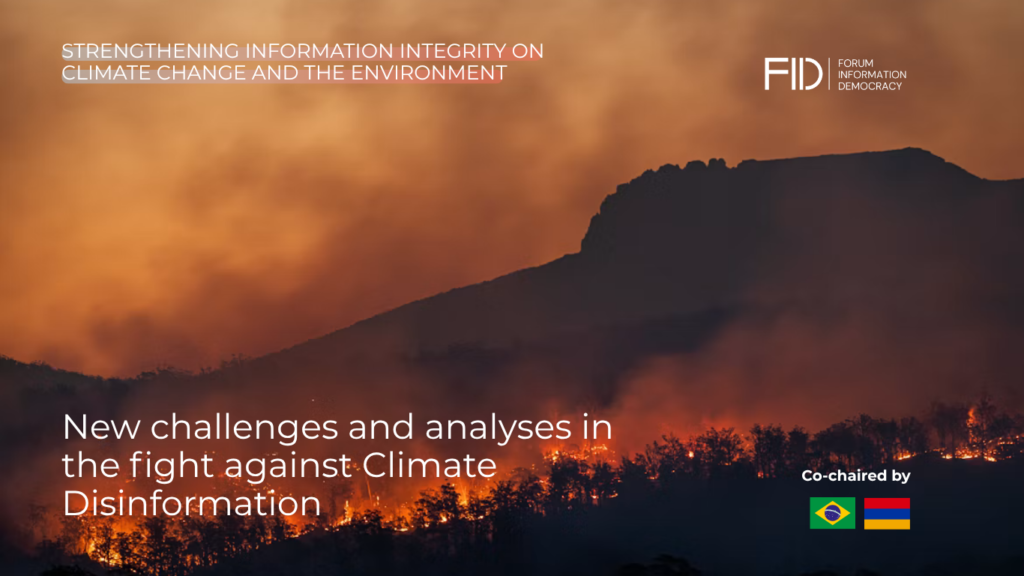
As extreme climate events increase in their scale and number, and as mis- and disinformation online reach unprecedented levels, it is imperative that citizens globally have access to reliable information, and engage critically with information they encounter. The latest meeting of the workstream served to highlight States’ policies to build resilience.
On 15th April 2026, the Forum on Information and Democracy held the sixth overall and the first annual meeting of the Workstream on Information Integrity on Climate Change & Other Environmental Issues, co-chaired by Brazil and Armenia. It gathered representatives of signatory States of the Partnership as well as civil society experts and researchers.
This meeting focused on first insights from States’ practices, policies and legislations to promote information integrity on climate change based on a questionnaire that was addressed to PID Signatory States. The meeting also allowed discussions on novel policy interventions to build societal resilience and promote climate and media literacy.
Introducing the meeting, Camille Grenier, Executive Director of the Forum on Information and Democracy, stressed the Forum’s determination to push for information integrity to be integrated into climate governance, notably through the Action for Climate Empowerment (ACE) framework, and reiterated the Forum’s commitment to facilitating bilateral discussions with governments to gather insights for the workstream’s second year of work.
Current Policy Responses
The first insights of a questionnaire shared by the Forum with States of the Partnership were presented. This questionnaire investigated national strategies, institutions, legal and regulatory measures, media literacy campaigns, protections for climate journalists and emergent challenges regarding information integrity on climate change and the environment. The questionnaire is aligned with the Bélem Declaration on Information Integrity on Climate Change and will provide concrete insights into where countries stand in terms of its implementation.
The first insights show that most governments do not have standalone national strategies regarding information integrity on climate and environmental issues. Information integrity on the subject is primarily addressed through a combination of broad digital regulation frameworks, media literacy strategies, national climate laws and plans, and legislation to protect journalists.
As Renata Negrelly, Advisor at Brazil’s Secretariat for Digital Policies noted, “the absence of universally accepted definitions related to environmental harms poses a structural obstacle to adopting regulations which are specifically focused on information integrity on climate.”
Case Studies from across the world
Several governments shared their experience in addressing the issue within existing frameworks, such as media laws and climate.
- Portugal is embedding environmental education at different levels of society, and building societal resilience to disinformation via the National Strategy for Environmental Education (2017). This takes place via environmental literacy campaigns across sectors and educational levels and embedding evidence-based information within state bodies and processes. It also uses multistakeholder strategies involving the private sector, local communities, CSOs and academia, expanding dialogue and promoting participatory processes.
- Brazil’s Climate Plan promotes access to information, education and participatory processes in building societal resilience. It is cross-cutting, with several pillars, and designed through a consultation process involving government bodies, consultancies, and civil society. It involves capacity building for digital influencers and communicators, training for civil servants, specific courses for teachers in different levels of education, and fostering research.
- France’s regulatory authority, ARCOM uses two approaches. Firstly, broadcasters’ agreements with Arcom now include a specific article ensuring that they contribute to efforts to combat climate change and to favor ecological transition. Secondly, ARCOM analyses disinformation about environmental issues, and holds broadcasters accountable for inaccuracies and climate denial, including via fines.
By adopting strategies to increase climate and environmental literacy, make evidence-based information more accessible, and increase public participation in climate action and decision-making, governments are now focusing on societal resilience to climate related mis and disinformation.
Next steps
As part of this workstream and in line with the COP30 Action Agenda, the Forum will continue the mapping exercise of states’ current legal and policy frameworks to combat climate disinformation and promote information integrity on the environment. This exercise aims to provide a ready-reckoner of the current state-of-the art, as well as in-depth insights on what states can implement.