Climate disinformation is not only employed to delay climate action, but is interconnected with other goals, such as foreign interference, as the conversations of the workstream highlight. This requires that governments think of comprehensive approaches to tackle the problem. Parliamentary inquiries and recommendations as well as new communications campaigns can play a role to protect the information space and ensure democratic debates.
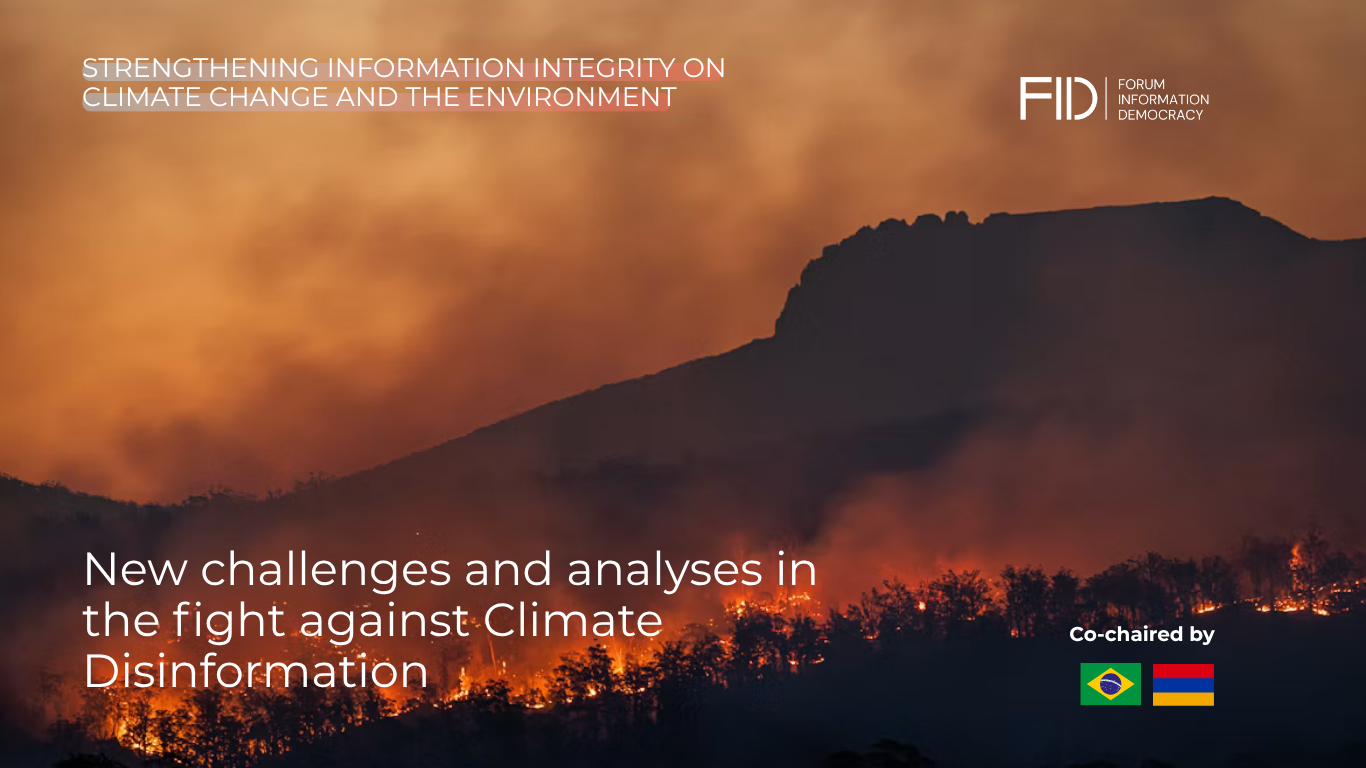
On 3rd June 2026, the Forum on Information and Democracy held the seventh overall and the second annual meeting of the Workstream on Information Integrity on Climate Change & Other Environmental Issues, co-chaired by Brazil and Armenia.
This meeting offered evidence about the nexus between climate disinformation and Foreign Information Manipulation and Interference (FIMI), a topic currently underresearched. It also provided insights into specific initiatives to promote information integrity such as parliamentary inquiries and communication approaches. In the run-up to the COP17 to be held in October 2026, the Forum will also release its interim report of the workstream, whose structure was presented.
How parliaments can aid the fight against disinformation
The Australian Senate Select Committee on Information Integrity on Climate Change and Energy presented their report of an inquiry conducted into the national climate disinformation landscape. This report looked at where disinformation campaigns are most powerful, who funds and exacerbates them, and new strategies employed by nefarious actors. The report provides concrete recommendations to the national government, such as employing robust digital regulation frameworks, supporting investigative journalism and monitoring efforts, and calling for the federal government to sign the Declaration on Information Integrity.
This is an example of parliamentary inquiries being important tools in understanding the latest challenges emerging from climate disinformation, understanding how citizens respond to these challenges, and instrumental in developing roadmaps for information integrity on climate.
How do FIMI and Climate Disinformation intersect?
According to the latest findings of the French Institute for International and Strategic Affairs (IRIS), climate disinformation is usually analysed as a domestic issue. Their research looking at disinformation emanating from the US and Russia however, reveals that climate disinformation is also part of FIMI strategies, taking three forms: misrepresentation of climate and energy policies (especially those of the EU), attacks on climate science and scientists, and disinformation around extreme weather events.
Ukraine is an example where climate-related disinformation serves the larger purpose of foreign information manipulation, such as hiding war crimes and eroding trust in public institutions. In response, the Ministry of Culture relies on active Open-Source Intelligence (OSINT) and rapid response investigative journalism communities alongside international cooperation to neutralise foreign climate disinformation. This is an example of how governments can collaborate with actors and influencers outside of traditional state bodies to establish a culture of vigilant and informed citizens.
Strategic communication approaches
Several stakeholders discussed novel awareness approaches in response to growing climate disinformation, and a necessity to ensure public access to reliable information and the ability to discern disinformation. In this context, the Brazilian government shared its efforts regarding a draft bill on fighting climate disinformation.
The EU presented the Commission’s #ClimateFactsMatter campaign – aimed at reaching ‘climate bystanders’ – targets sections of populations deemed to be most vulnerable to influence campaigns. It showed that short-form content with simple messages aimed at capturing audiences’ attention are an effective way to communicate a conceptual topic such as climate disinformation to non-specialist audiences, subsequently empowering them to detect false and inflammatory climate mis- and disinformation.
Next Steps
As COP17 is approaching, the government of Armenia expressed its commitment to use that platform not only for advancing biodiversity efforts, but also for ensuring that the conditions for these efforts’ success – including public trust and information integrity – are met. To support these efforts, the Forum will publish the findings of its mapping ahead of COP17 providing a roadmap for States to adopt a whole-of-society approach and have access to best practices and country examples.